

(Credit for the voiceover for this article goes to the great Samuel Lipson)
It never even really began.
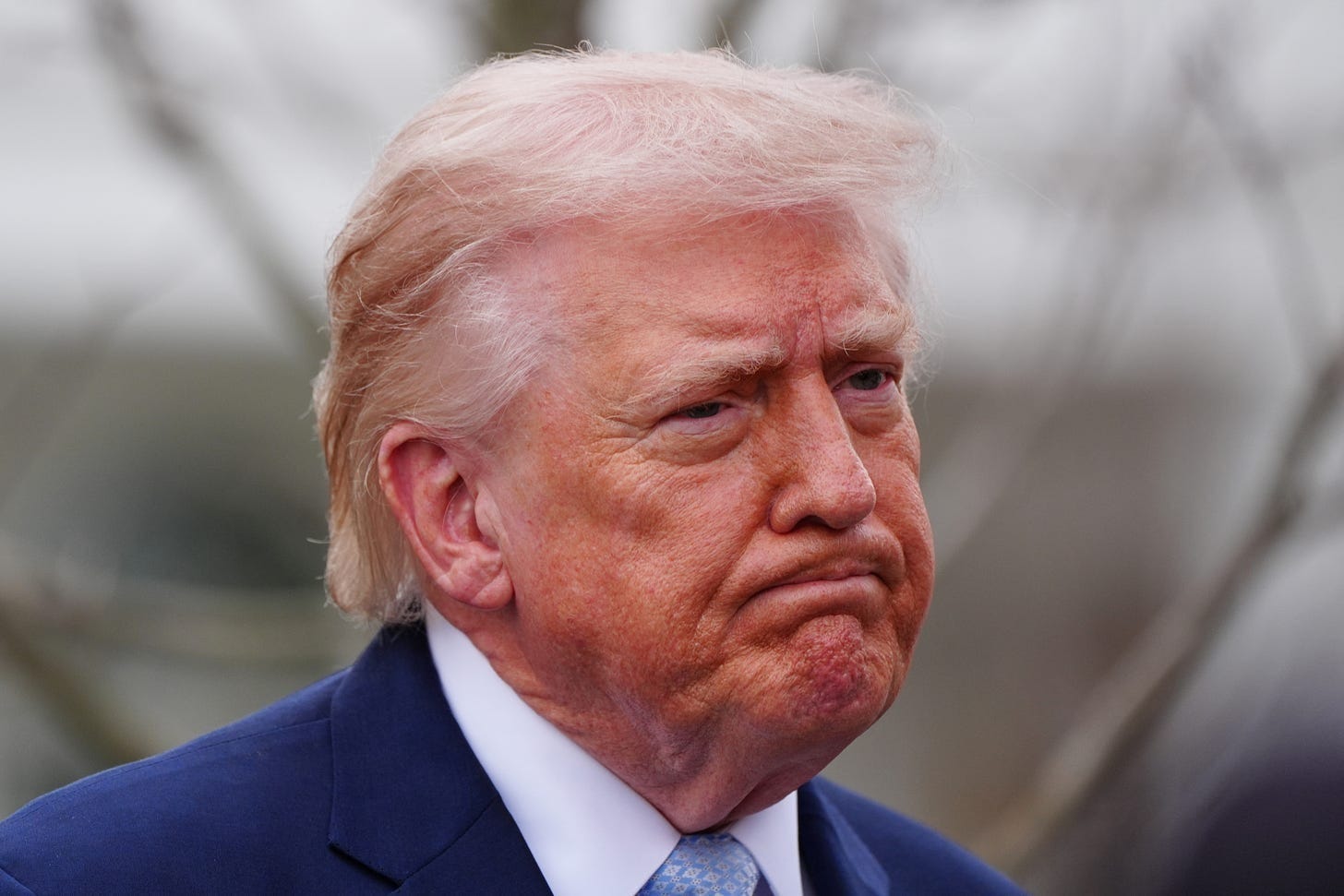
Donald Trump has never been a popular politician. This is not to say that he is not well-liked by some, which he is, or that he doesn’t have unique political skills, which he does. It is to simply recognize an objective fact: that among all of the voters living in the country that he has twice led, more people have disliked Donald Trump than those who have liked him for nearly every single day of his 11-year-long political career. This was true throughout his entire first campaign, his entire first presidency, and the entire span of his first post-presidency. Even at the height of the post-election “vibe shift” period, when the entire world was prostating itself at his feet, even his most favorable aggregators were only able to give him a one-point net positive favorability rating for a grand total of four nonconsecutive weeks. That was what his entire honeymoon amounted to. Since then, his standing has fallen, fallen, and fallen some more, all the way down until now, where he’s once again despised by a solid majority of the public.
What should one make of such a politician? They should avoid overthinking it. The correct conclusion about the biggest question in modern politics has always been the single most obvious one: that President Donald Trump—the idiotic, corrupt, and elderly President Donald Trump—is a bad politician. That there is nothing more to him than meets the eye, and that a clearly inept blowhard is about as popular as clearly inept blowhards usually are. That his two victories only came about as a result of his opponents being dumb enough to insist on running their own inept hacks, and that he has no political room to breathe when he lacks such easy foils. Everyone—and I mean everyone—knows this, very much including the right-wing commentators who have spent years propping up his mythology. We know that they know this because they screamed it at the top of their lungs every time that they felt like they had an inch of room to do so. Not only did they say this when he first ran, but they did so as recently as 2023, when they were all desperate for Ron DeSantis to be the nominee in his stead.
They shouldn’t have changed their minds. Their opponents shouldn’t have changed their minds either, even after they lost. There was never any point in anyone ever lying to themselves. Far from any sort of generation-defining realignment period with Trump at its head, the past decade of American politics has always been best understood as an extremely high stakes game of chicken, where both major parties have attempted to leverage the unpopularity of their opponents to force their own highly risky comfort characters into the White House. Both Republicans and Democrats spent the past decade skirting right on the edge of viability, hoping against hope that voters would find their opponent to be so odious that would leave them with no choice but to go with their side. In the long run, the real risk was not that one would lose while attempting this gambit, but that they would actually win and become completely locked in to a fundamentally flawed way of doing things while their opponents regrouped. Now, thanks to Trump’s helpful insistence that the 2020 election was stolen, the party that is stuck in a state of fatally arrested development is the GOP, while it is the Democrats who have been dragged kicking and screaming into imagining a kind of politics that doesn’t revolve around blackmailing the public into electing their favorite elderly crook.
It is along these lines that the great unraveling of the supposed right-wing populist coalition of the future has occurred over the past year. As the clock ticks down to the midterms, things have become very, very, very dire for Republicans—significantly worse than how things looked not all that long ago. As recently as last fall, one could still look at the 2026 midterms in light of the reasons they had for hope: the unpopularity of their opponents, their resilience among electorally important demographics, and the longstanding structural advantages that have bailed them out countless times before. Since the start of the Iran War, this is no longer the case. Unlike past elections where things simply looked “bad” for Republicans, we have now entered truly uncharted territory. There are no more silver linings. There are no more moral victories. There are no more little games left to be played.
There is no floor.