

(Credit for the voiceover for this article goes to the great Samuel Lipson)
In case you haven’t heard, Pete Hegseth has a lot of tattoos.
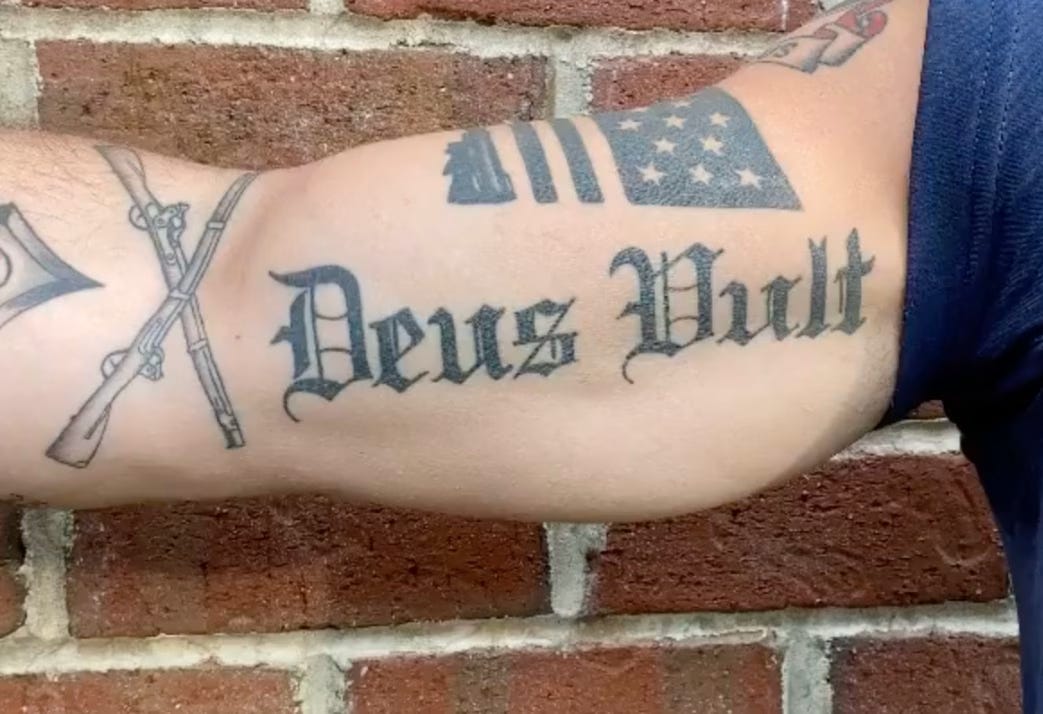
The first thing to say about them is that they look hideous. The second is that they are concerning, if only because of how many of them relate to a certain theme: the Crusades. Not some metaphorical crusade, mind you—the actual ones. Pete Hegseth, our Secretary of Defense, has covered his body with symbols from the actual armed conflicts that took place nearly 1000 years ago. There is, of course, that large Jerusalem cross—the literal coat of arms of the ill-fated Crusader Kingdom of Jerusalem—placed prominently on his upper chest. From there, one can move down to his lower arm to see a cross with a sword. That’s a reference to Matthew 10:34, a Bible verse that modern Christian nationalists use as justification for religious violence. And right next to it, there are the two Latin words emblazoned on his bicep: “Deus Vult,” or “God wills it.”
Despite the fierce competition, that “Deus Vult” tattoo proved to be the most controversial of the symbols that Hegseth had stamped upon himself after he was nominated to serve as Secretary of Defense in November 2024. As many outlets quickly noted, the phrase had been widely used by white supremacist mass shooters and neo-Nazi during the 2010s. This made the nominee’s attachment to it quite concerning, even for those beyond the reaches of the so-called liberal media. But, as one might expect, all of the furor passed without any consequence. During his nomination hearings, Hegseth was questioned about the tattoos, defended them, and said that the scrutiny was a case of “anti-Christian bigotry.” Then he was confirmed to run the Pentagon and liberals gave up on the topic. Even when they train their fire on him today, they almost always go after the easiest targets, like his drunkenness and general incompetence.
Why have they punted on the tattoos? Perhaps they assume that Hegseth simply has enough plausible deniability to claim that whatever symbol they say is an icon of racial hatred is actually a simple expression of faith that dates back centuries. That may very well be the case with the Jerusalem cross, which is used as the flag of the country of Georgia to this day. It may even be true for Matthew 10:34, which has been referenced by preachers for thousands of years in countless different contexts. As for “Deus Vult,” however, things are a little more complicated. After it was used as a rallying cry during the era of the Crusades, the phrase completely fell off the map. For hundreds and hundreds of years, hardly anyone ever used it—not the church, not religious traditionalists, not even outright neo-medievalists during periods of renewed interest in the era. This only changed when it was suddenly revived as a white nationalist symbol in the 2010s.
Specifically after the year 2012.
Or, to be even more specific, after the Swedish video game company Paradox Interactive published Crusader Kings II, a grand strategy game set in the Middle Ages that used the phrase extensively.
You probably have a certain idea of how the rest of this article is going to go. After giving you an anecdote that connects the topic of Paradox games to something that’s a) concerning, b) topical and c) related to the Trump administration, I, as a left-wing political writer, will now go on to give a description of Paradox games that is as minimally informative and maximally fear-inducing as possible. With an inelegance that immediately tells Paradox gamers that I have never played any of the titles, I will give a rough, largely incorrect, and hostile overview of grand strategy gaming that presents the entire genre as nothing more than a digital radicalization factory that turns impressionable young people into fascists. It’s not as if I will have a lack of material to work with—not when the company’s most popular title is a World War II simulator that lets you literally play as Hitler. I will then close with some vague handwaving about how fucked up the internet is, imply that the games shouldn’t exist, and then go about my day having provided absolutely no useful information to anyone anywhere.
I am not going to do this, and it is because I have a confession to make: I love Paradox games. I have played them ever since I was in middle school and I still play them to this day. For a span of roughly five years, they were practically the only video games I played on my computer. I’m also—dare I say—pretty good at them.

While I have more than my fair share of my issues with the games, I really do like them a lot, and I do not regard them as far-right schemes meant to drive young people to love Hitler and hate Muslims. That sort of framing may be easy, but it is wrong, and it says nothing about what the popularity of these games among politically-inclined young people actually means. Instead, I am going to look at things from a different angle. In this article, I will cover what happened after young politics obsessives—specifically young politics obsessives on the right—picked these games and joined their communities over the course of the 2010s. This is because understanding the design choices made by Paradox Interactive during this period is the skeleton key to understanding why young right-wingers today are so utterly bizarre. Between their obsession with war to their unprecedentedly favorable views towards state power, almost every element of their fascistic worldview can be traced back to video game mechanics designed by well-meaning Swedish liberals responding to technical limitations and market pressures.
I’m serious. This isn’t an exaggeration. It’s where we are now, and it’s where you’d expect us to be now that video games are bigger than movies and music combined. So, without further ado, here’s the first look anyone has ever given at the biggest political influence on the next generation of Republican staffers and politicians, why they were designed the way they were, and how larger budgets and improved processing power might also change the world by giving us a new generation of historical materialist gamers.