

“America is a thing you can move very easily, move it in the right direction. They won’t get in our way”
— Benjamin Netanyahu, 2001
“We see what we want to believe.”
— Robert McNamara, 2003
(Credit for the voiceover for this article goes to the great Samuel Lipson)
In the early hours of February 28th, 2026, a fringe foreign policy project several decades in the making finally reached its logical, bloody conclusion. With hardly any justification, pretense, or any other kind of attempt at public persuasion, the United States and Israel launched a full-on regime change operation against Iran that succeeded in assassinating the country’s 37-year Supreme Leader and plunging the entire region into a near-unprecedented state of chaos. Nobody knows how the war is going to end. Not even our loudmouth dipshit of a president is willing to even say how long it will last. Yet just the fact that it is even happening at all provides us with one certainty: that Israel, less than three years removed from the abject humiliation of October 7th, is in the strongest military position that it has ever been in.
Yes, it’s true. That endless faucet of American dollars and weaponry has done the trick. At the same time that it has conducted its genocide of Palestinians in Gaza, Israel had successfully tied up a great number of foreign policy loose ends in the years since 10/7. With the notable exception of the Houthis in Yemen, the once-vaunted Axis of Resistance was reduced to Iran and Iran alone with shocking speed, thus obliterating the few obstacles that kept the Zionist state from acting with complete and total impunity in the decades prior. After that point, an intervention of this scale was only a matter of “when,” not “if,” especially with this administration in the White House. It might not have occurred the precise way that Netnayahu planned it, but he has gotten what he has wanted for more than 40 years.
It’s a watershed moment. And in a great moment of historical irony, it took place less than 24 hours after another defining historical moment involving the same exact country, the same exact plans, and the same exact long-term relationship. But instead of bombs, drones, and the charred ruins of elementary schools, this first one in the form of a sample size of 1000 American voters.
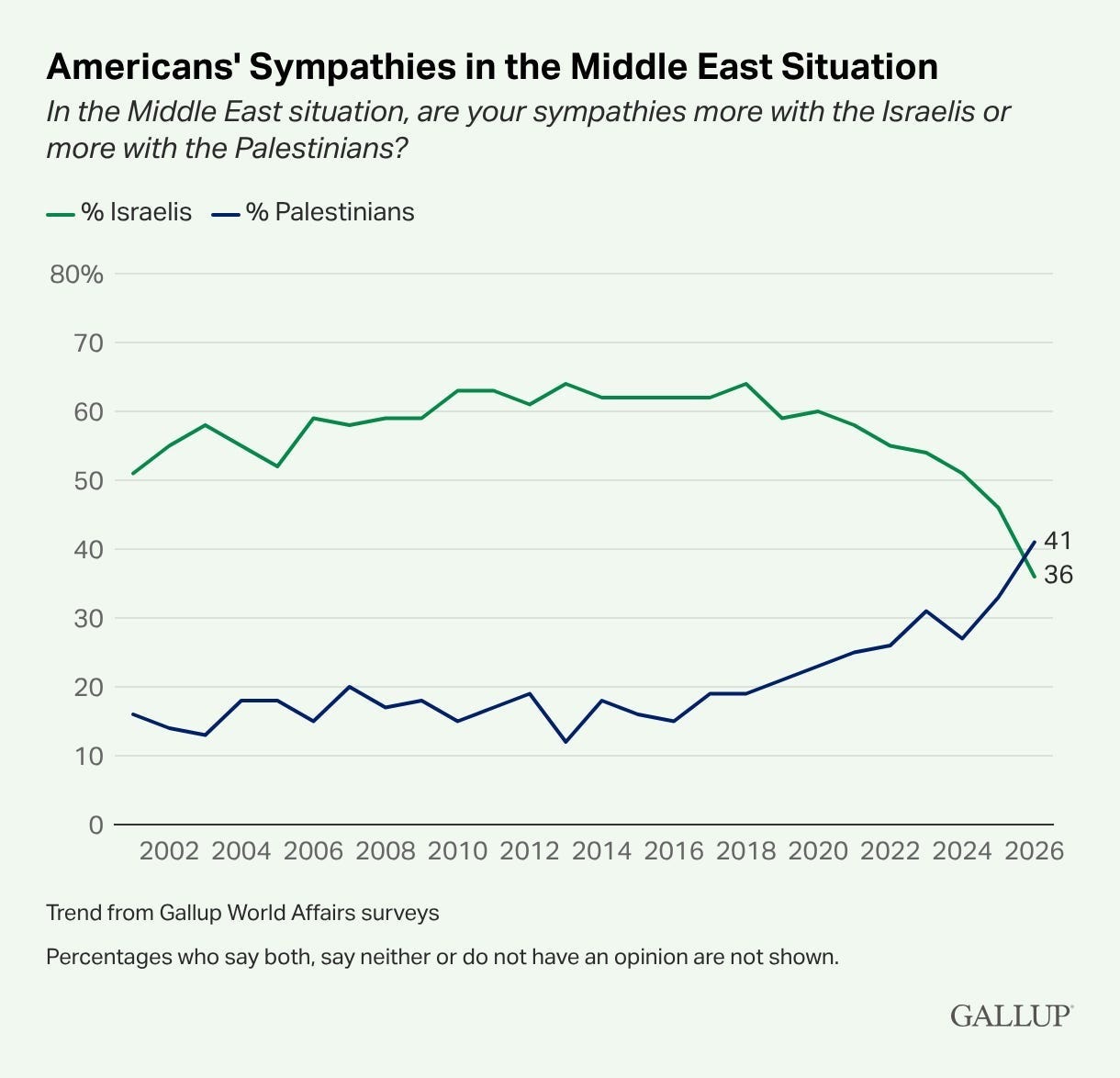
As the Zionists and their allies have used post-10/7 elite sympathy to realize their wildest geopolitical fantasies, the foundation of public American support that their entire project has always rested on has completely shattered. Far from the rare source of bipartisan consensus that it is supposed to be, pro-Israel politics and pro-Israel policy have instead become the political equivalent of a termite infestation. They’ve divided otherwise rock-solid bases of support and branded entire presidencies as out-of-touch and corrupt, so far undermining the popularity of two seperate administrations of two seperate parties since the start of the genocide in Gaza. For aspiring American politicians—especially those who are a part of the currently-ascendant Democratic Party—the once-mainstream stance towards Israel is completely politically unviable, no more so than among the young voters of the future who sympathize with Palestinians by a staggering 30 points on margin.
As this shift and its consequences become ever-clearer and politically relevant in the coming years, you’re certain to hear commentators of all stripes talk about it as a completely unprecedented break from a continuous pro-Israel stance that America has held ever since the country’s founding. It’s a flashy, dramatic story that holds some grains of truth to it, but I don’t believe that it is the best way to understand the story of the American relationship with Israel. Far from an unbroken, 70+ year status quo, the modern era of AIPAC-driven Israel-first policy is itself a major historical aberration: a highly ideological product of a very specific set of circumstances that was only ever capable of sustaining itself in the shadows. If—when—America returns to a sane foreign policy and stops prioritizing Israeli interests over all else, it won’t be doing anything unprecedented or unheard of. It will be returning to an approach it took within living memory under the leadership of staunchly conservative Republican presidents—one that had been abandoned and still could have been abandoned had Israel itself not brought it back from the dead.
This is not the story that Israel and its allies wanted to happen. It is not a tale of the country’s so-called “America whisperer” manipulating a superpower’s politics to his own ends, successfully establishing his nation as a heroic figure in Western popular culture, and expertly navigating an era of ultrapolarization. It is instead the story of an arrogant egomaniac completely ruining a streak of generationally good luck through his sub-Hillary Clinton understanding of the American public. It is the story of countless pyrrhic victories, each of which put another crack in what should have been an unbreakable foundation of support. It is the story of a country and a lobby that has won countless battles, but is losing the war.
It is the story of how Israel lost the 21st century.