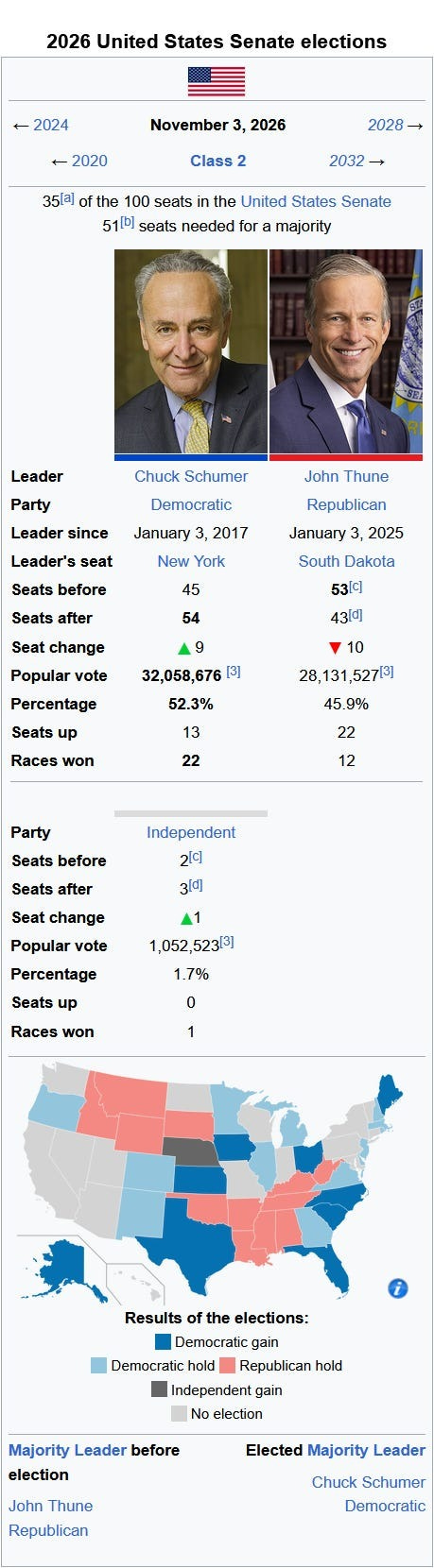
With only six weeks to go until Election Day 2026, the Democratic Party is running against history. If Republicans ever once had a hope of meaningfully contending for another trifecta, it is now long gone, sunk somewhere at the bottom of the Strait of Hormuz. Despite all of their efforts to lie, cheat, and outright rig the elections this year, the backlash to the incumbents and their failed policies has grown far too large for them to manage or survive. As things stand, quantitative models have the odds of a Democratic House majority above 90%, while a once-seemingly unwinnable Senate now outright leans in their favor.
It all raises a question: what, exactly, is on the line over the next month-and-a-half? Back in 2018 and 2022, the stakes of the upcoming elections were clear and obvious: whether or not a party that had just suffered a devastating defeat would be able to rebuild a national coalition, win at least one chamber of Congress, and obstruct the new President’s agenda for the next two years. This time around, these defining questions appear to have already been answered. There’s little doubt that Democrats will take at least one chamber of Congress this November, little interest in the fact that they’re rebounding yet again after a loss, and—most crucially—little thought that anything we’re seeing right now matters at all in the long term. Even if Democrats run up the score and secure victories in Alaska, Iowa and beyond, it is simply assumed by pundits that the political status quo we’ve known for the past decade will continue as usual.
It’s an incredibly outdated perspective. While midterm cycles may always lack the star power of presidential ones, they have long been just as consequential. Thanks to our historically small pool of consistently competitive swing states and ultra-polarized electorate, governing parties can no longer expect to quickly recover from devastating midterm cycles in the way they once could, just as they can no longer credibly dismiss losses in safe states as flukish, low-turnout oddities. As such, it is not an exaggeration to say that the next decade of American political life will be defined by what happens in November six weeks from now. The kind of candidate Democrats will nominate in 2028, the direction of the post-Trump GOP, the possible ambitions of the next White House—the answers to all of these all-consuming questions will be determined by the degree to which the opposition runs up the score in this moment of overwhelming anti-Trump sentiment.
So, again: what, exactly, is on the line over the next month-and-a-half? What would it mean for America and the world in 2028 and onward if Democrats absolutely thrash the GOP and secure the kind of towering majority they haven’t had in decades? What happens if they “just” flip their most promising targets and get a solid majority? What happens if they fall short of winning it, and what happens if they do so while fumbling well and truly winnable races? All of these scenarios will be considered here, starting first with the most intriguing one: the one where the Republican Party completely dies.
Scenario One: A Blue Megatsunami, or; (Angie) Nixon Now